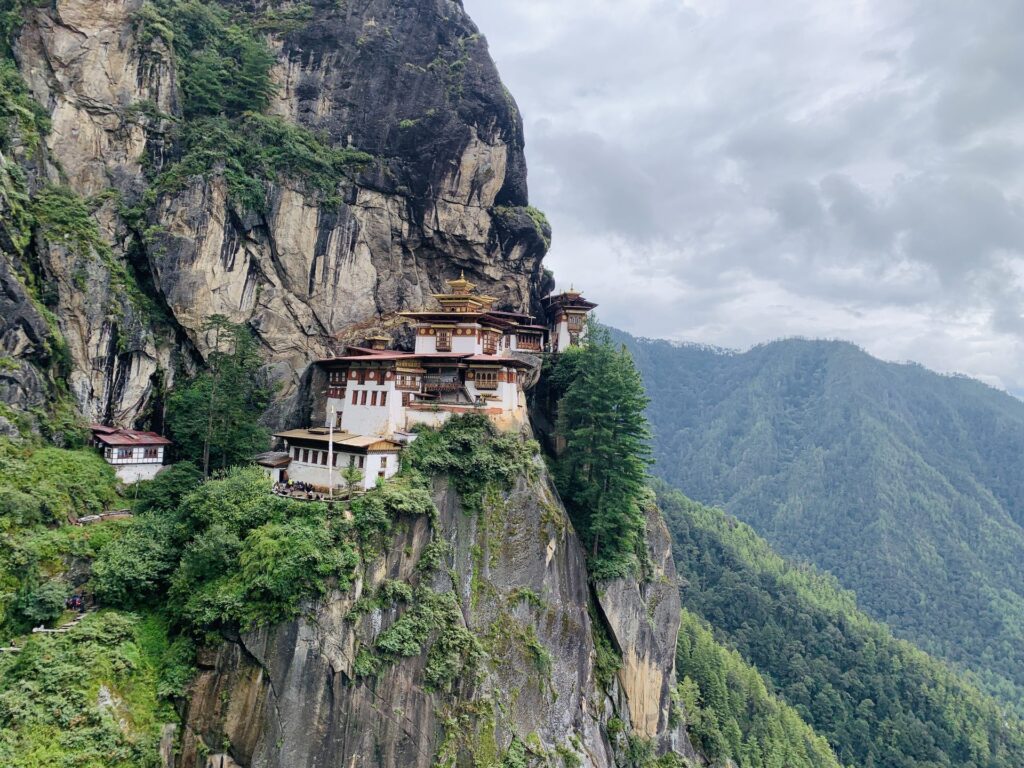
We are not visiting.
We live here.
A small team in Thimphu, designing private journeys through the country we grew up in.
Why we started
For most of my childhood, the walk to my grandmother’s house in Punakha took four hours. There was no road then — only a path above the Mo Chhu and a suspension bridge that swayed enough to make you concentrate. I remember the smell of pine, and the particular quiet that arrives in a valley at dusk.
Years later I began guiding visitors through those same valleys, and I noticed something about the itineraries they arrived with. They were efficient. They were also, mostly, wrong — built by people who had never stood in a dzong courtyard at six in the morning when the monks begin, or waited out a mountain fog that turned out to be the best hour of the day.
Aether Bhutan began because I wanted to build the other kind of journey. Slower. Fewer places, understood properly. Designed by people who know which lama will actually receive you, which lodge has the view worth the extra hour of driving, and which festival is worth rearranging an entire trip around.
We are a small team and we intend to stay that way. We take a limited number of guests each season, because a journey designed carefully cannot be designed at volume.
If you are thinking about Bhutan, write to me — not a form, an actual letter about what you’re hoping for. I read them all.
Four things we don't
compromise on
Fewer places, more time
Most Bhutan itineraries move you every night. Ours rarely do. You cannot feel a valley through a car window, and the third morning somewhere is usually the one you remember.
The guide is the journey
A good guide is not a narrator. They’re the person who knows when to explain and when to let a courtyard stay silent. We pay ours properly and keep them for years.
Access is earned, not bought
Our relationships with monasteries, artisans and families took years to build and we treat them carefully — which is also why we never promise access we can’t deliver.
Honest counsel
If March is the wrong month for what you have in mind, we will say so. We would rather lose a booking than design a trip we don’t believe in.
Who you'll actually travel with
Not a call centre. The person who designs your journey is the person who meets you at Paro.
Your Travel Designer
The person who draws your route and answers your emails. Every proposal that leaves this office is written by hand, never assembled from a template.
Your Guide
One guide from Paro arrivals to Paro departures — never a different person in each valley. Licensed by the Department of Tourism, and matched to the journey rather than to the calendar.
Your Driver
Bhutan’s roads ask a great deal of a driver. Ours know every pass, every place worth stopping, and when to suggest one.
How a journey comes together
Conversation
A call, or a long email. What you enjoy, what you’d rather avoid, and how you actually like to travel.
A written proposal
A day-by-day draft with the reasoning behind every choice — an argument for this route, in this order.
Refinement
We revise until it’s right. Most journeys go through three or four drafts, and that is entirely normal.
On the ground
Your guide and driver, a local number that always answers, and someone in Thimphu keeping an eye on the weather.
Tell us what you're imagining
Even if it’s vague. A season, a feeling, a photograph you saw once — that is usually enough for us to begin.