How to get into Bhutan
One international airport, two airlines, and one of the more interesting approaches in commercial aviation.
Two ways in
You either fly into Paro — the only international airport in the country — or you cross a land border from India. Almost everyone flies.
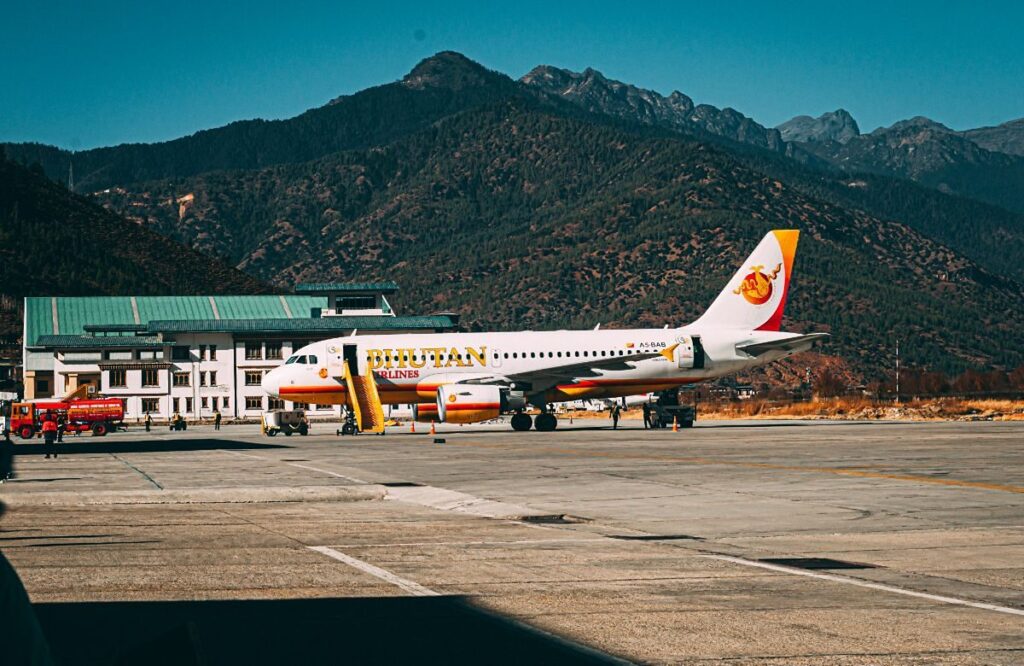
Only two carriers serve Bhutan: Drukair, the national airline, and Bhutan Airlines. Between them they connect Paro to a handful of Asian cities. No other airline flies here, which means fares are what they are and seats in October go early.
Flights operate in daylight only, and only in reasonable visibility. Build a buffer day at each end of your trip — we will explain why below.
Where you can fly from
Routes and frequencies shift by season — confirm with us when you plan.
The most common long-haul connection. Good onward links from Europe, Australia and North America.
Frequent and convenient if you are combining Bhutan with India.
The scenic one — Everest, Kanchenjunga and Jomolhari from the left-hand window on a clear day.
Useful for travellers coming from Australia and Southeast Asia.
The short hops. Bagdogra is also the gateway if you are entering overland.
Regional connections, less frequently served.
Schedules change seasonally and both airlines adjust routes at short notice. We book your Paro flights alongside the rest of your journey so a change never leaves you stranded.
The approach into Paro
Paro sits at 2,235 metres in a narrow valley ringed by peaks rising above 5,000. There is no instrument approach. Aircraft descend visually, banking between ridges close enough that passengers routinely reach for their phones, and only a small number of pilots hold the certification to fly it.
This is why flights are daylight-only and why they are cancelled or delayed when the weather closes in — usually in the monsoon. It is not a safety concern so much as a scheduling one.
Two practical points. Leave a buffer day before any onward international flight; a delayed departure from Paro should never cost you a connection home. And flying in from Kathmandu, ask for a seat on the left.
Crossing by land
Three border towns, all from India. You still need the same visa, arranged the same way.
The main crossing, and the one most overland visitors use. Nearest airport Bagdogra, about four hours away. From here it is a six-hour drive up to Thimphu — spectacular, and long.
Central, and useful only if you are starting in Bumthang or central Bhutan. Rarely used by visitors.
The eastern crossing, near Guwahati. Sensible if you are travelling Bhutan east to west — a genuinely unusual itinerary.
What happens when you land
Paro is a small airport and the process is quick. Immigration stamps the visa into your passport against the clearance letter we send you in advance. Bags come through in minutes.
Your guide and driver will be waiting in the arrivals hall — the same two people who will be with you for the whole journey. Paro town is twenty minutes away; Thimphu is about an hour and a half.
Flights, visa, and the buffer day
We book your Paro flights with the rest of your journey, so a schedule change is our problem rather than yours.