
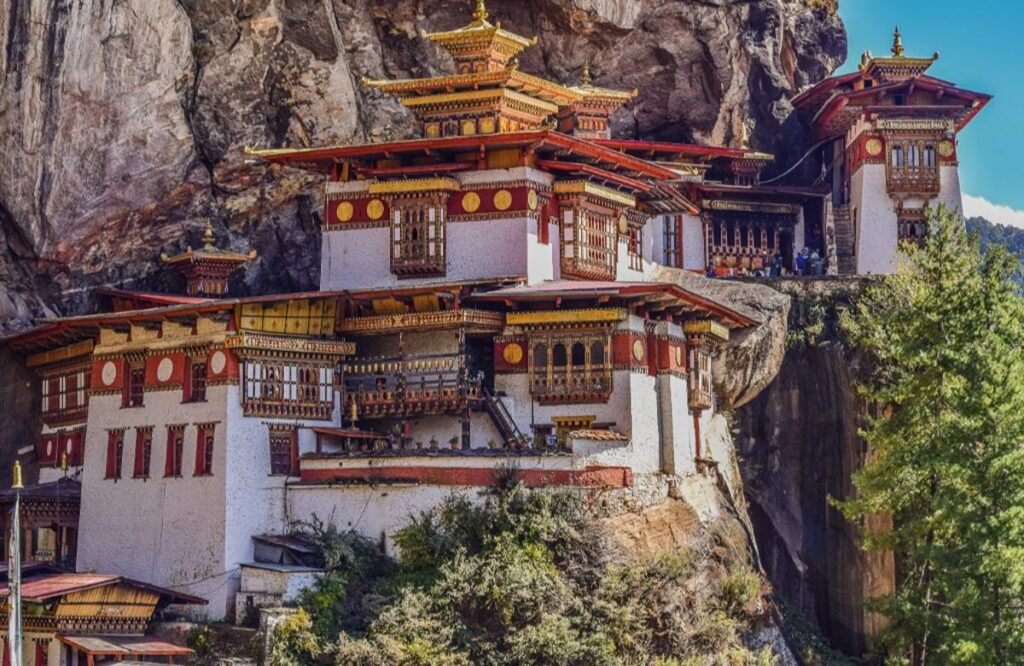
Almost everyone who writes to us mentions the Tiger’s Nest, usually in the first paragraph, sometimes before they have mentioned dates. And almost everyone asks the same quiet question underneath the excitement: will I actually be able to do it?
Here is an honest account of the Tiger’s Nest hike, from people who walk up there most weeks of the season.
What you are actually climbing
Paro Taktsang — the Tiger’s Nest — sits roughly 900 metres above the floor of the Paro valley, on a granite face that offers no obvious reason why a building should be there at all. The monastery itself is at about 3,120 metres. The car park where you start is at around 2,600 metres. So you are gaining a little over 500 metres of height — less than many people imagine — but you are doing it on a path that climbs almost continuously.
The traditional account says Guru Padmasambhava arrived here on the back of a flying tigress and meditated in the cave for three years, three months, three weeks, three days and three hours. The buildings you see wrapped around that cave were founded in 1692. A fire gutted the main structure in 1998; the restoration was finished in 2005, which is why the woodwork looks newer up close than the photographs suggest.
It is not a technical climb. There is no scrambling, no exposure, no equipment. It is a long uphill walk at altitude, and the altitude is the part people underestimate.
How hard the Tiger’s Nest hike really is
If you can walk uphill for two hours without stopping to worry about it, you can do the Tiger’s Nest hike. We have taken people in their seventies to the top. We have also watched very fit thirty-year-olds struggle, because they arrived in Paro the previous evening and started climbing before their body had any idea where it was.
Fitness matters less than acclimatisation. That is why we almost never schedule Taktsang for the first full day of a journey. Two or three days in the valleys first — walking a little, sleeping at 2,200 metres — changes the experience completely.
The three sections
- Car park to the cafeteria. A steady climb through blue pine, wide path, prayer flags overhead. Most people take 60 to 90 minutes. This is where the altitude introduces itself.
- Cafeteria to the viewpoint. Another 45 minutes or so, gentler, and the moment the monastery appears directly across the gorge is the one everybody remembers.
- The staircase. Several hundred stone steps down into the gorge, past a waterfall and a curtain of prayer flags, then the same again up the other side to the entrance. Short, and the hardest part of the day — particularly on the way back, when you have to climb out.
How long to allow
| Pace | Up | At the monastery | Down | Total |
|---|---|---|---|---|
| Steady | 2 hrs | 45 min | 1.5 hrs | about 4.5 hrs |
| Unhurried | 3 hrs | 1 hr | 2 hrs | about 6 hrs |
We build a whole morning around it and do nothing demanding afterwards. People who schedule a long drive for the same afternoon regret it.
When to start
Early. We aim to be walking by around eight o’clock. Three reasons, in order of how much they matter:
- The path is quiet, and the first hour in cold air under pines is genuinely lovely.
- Cloud tends to build through the middle of the day. The clear view of the monastery is a morning event.
- You are back down for a long lunch instead of racing the light.
Which months are best is a larger question, and we have written about it in detail on when to visit Bhutan. In short: the path is walkable year-round. March to May and September to November give you the clearest air. Winter mornings are cold and startlingly clear, and the trail is almost empty. Monsoon afternoons turn the stone slick, so you start even earlier.
Horses, and why we are careful about them
Horses can carry you as far as the cafeteria. They cannot go beyond it, and they do not come down — you walk the descent regardless.
We will arrange one if you want it, and we sometimes suggest it for guests who are worried about the first section and want to save their legs for the staircase. But it is worth knowing what you are choosing: the ride is not especially comfortable, the path is narrow, and you spend it looking at the ground rather than the valley. Most people who take a horse up tell us afterwards they wish they had walked.
What to bring, and what to leave
- Layers. You will start cold and be warm within twenty minutes. The monastery interior is cold again.
- Proper shoes. Trainers are fine in dry weather; anything with grip is better on the steps.
- Water. More than you think. There is a stall at the cafeteria.
- Long trousers and covered shoulders. This is an active monastery, not a viewpoint.
- A hat and sunscreen. The sun at 3,000 metres is stronger than it feels.
Leave your camera and phone in the car or hand them in at the entrance — photography inside is not permitted, and the deposit desk is the only option once you are there. We mention this because people are often disappointed, and because it is, in practice, the best thing about the last hour. Nobody is holding up a screen. You look at the thing itself.
What the Tiger’s Nest is like inside
Smaller than you expect, and darker. A sequence of small temple rooms linked by steep wooden stairs, butter lamps, the smell of juniper, and the cave itself behind a gilded door that is opened only on certain days. There are usually a handful of monks, and usually no ceremony — this is a working monastery on an ordinary morning, not a performance.
Most people sit for a while on the terrace before going back down. We build that pause into the timings on purpose. It is the part you will remember.
A few ways to do it differently
If the standard out-and-back does not appeal, there are two approaches we like more.
The first is to reach it from above. On Rapids and Ridgelines we camp overnight at Bumdrak, on the ridge high above the monastery, and descend to Taktsang the following morning — arriving from a direction almost nobody uses, with the cliff below you rather than above.
The second is to arrive already acclimatised and already walking. The Druk Path trek finishes with a rest day at Taktsang, by which point five days on high ridges have made 500 metres feel like very little.
Both are in our full collection of journeys, and both can be rebuilt around whatever else you want to see. If you are still working out where Taktsang fits alongside Punakha, Bumthang and the east, our guide to places to visit in Bhutan lays the valleys out in order.
The one thing we would say
Do not treat the Tiger’s Nest hike as a box to tick on your first morning. Give it a whole day, halfway through your trip, when you have stopped being jet-lagged and started noticing things. It is a much better walk when you are not trying to survive it.
If you have a specific worry — a knee, a heart condition, a genuine fear of heights, a child, a parent who walks slowly — tell us. We have almost certainly worked around it before, and we would rather plan properly than reassure you vaguely. Write to us and ask. More practical questions are answered on our travel FAQ.